
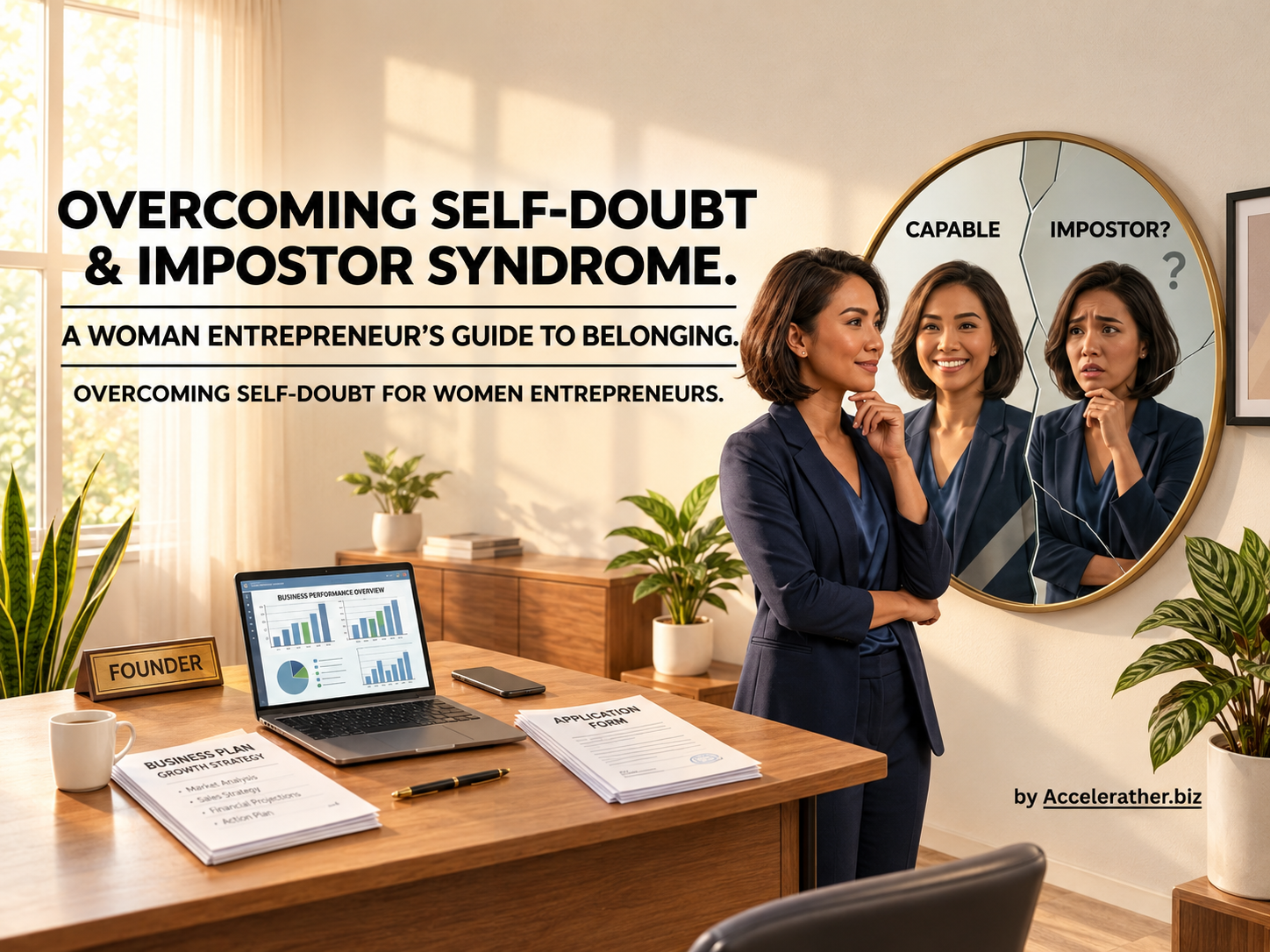
The Founder’s Mirror — Overcoming Self-Doubt and Impostor Syndrome as a Woman
You’ve built something from nothing. You’ve navigated the complexities of registration, funding, and market entry. Yet, a quiet voice persists: “Do I really belong here? Will they find out I’m not as capable as they think?”
If that sounds familiar, you are not alone. Impostor syndrome is one of the most pervasive yet least-discussed barriers in entrepreneurship—particularly for women founders.
The Reality Behind the Silence
A 2025 NerdWallet survey found that only 23% of female business owners considered themselves financially successful, compared to 32% of their male counterparts. A separate Mastercard study in Spain revealed that 24% of women entrepreneurs cited a lack of self-confidence as a concern when creating their businesses—while zero men reported the same feeling.
The confidence gap is not a character flaw. It is a systemic pattern, shaped by cultural expectations, representation gaps, and the exhausting need to prove competence twice as hard.
Real Case: Marcia Kilgore and the Persistent Voice
Consider Marcia Kilgore, founder of Bliss Spa, Soap & Glory, FitFlops, and Beauty Pie. She sold her first venture to luxury giant LVMH. She built multiple global brands. By any external measure, she has “made it.” And yet, in a 2026 BBC interview, she openly admitted that impostor syndrome remained—even after deals with LVMH and Boots. Her experience reveals a vital truth: success does not silence self-doubt. What changes is your willingness to act despite it.
Global Research: Fear of Failure as a Gendered Barrier
A 2025 study using Italian Global Entrepreneurship Monitor data found that women are approximately 30% more likely to report fear of failure and 20% less likely to feel self-efficacious—even when they perceive high social respect for entrepreneurs. The barrier is not competence. It is the internal permission to try, fail, and try again.
How to Work Through It
- Name it. Say: “This is impostor syndrome speaking.”
- Keep evidence. Track wins in a “done list.”
- Find your circle. Join peer networks where women founders share honestly.
- Act anyway. Confidence follows action, not the other way around.
You don’t need to eliminate self-doubt. You need to lead despite it.